
Pluto
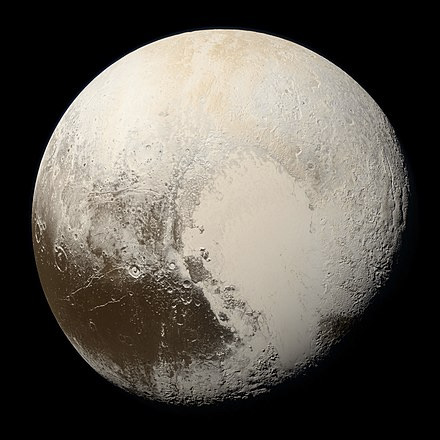
In 1930, Pluto became officially the ninth planet after Neptune. It is the largest trans-Neptunian by volume. It is less massive than Eris. Pluto is composed of ice and rocks.
Pluto was discovered on February 18th, 1930, by a 23-year-old named Clyde Tombaugh. He worked at the Lowell Observatory in Arizona. His job was to take photographs of the sky at night and then rapidly shift images back and forth to see if any objects in the sky changed positions. Clyde discovered on photographs taken on January 23rd and 29th that an object changed places. A photograph of low quality taken on January 21st confirmed indeed that there was a moving object.
Video of Ceres
Ceres
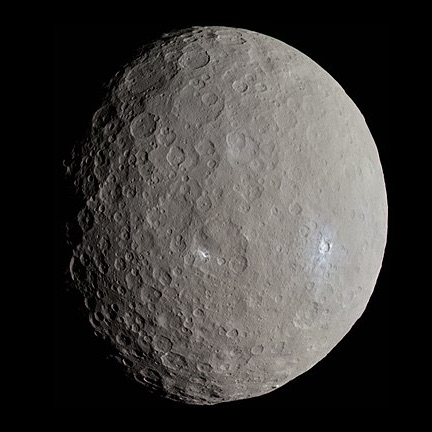
Ceres is small even if it can’t be seen by the naked eye. It can only be seen at night only when it is extremely dark. It is made out of water ice, carbonates and clay which are hydrated minerals.
On January 1st, 1801, Guiseppe Piazzi discovered Ceres at the Palermo Astronomical Observatory in Sicily. There has been some debate about Ceres’ classification. It was originally planet. In the 1850s, it was considered an asteroid. Since 2006, Ceres is a dwarf planet and has not changed categories since.

Eris
Eris is the biggest dwarf planet and the most massive object that has not been visited by any spacecraft. NASA thought that it was larger than Pluto and therefore, stated that it was the “tenth” planet in the Solar System. New Horizons measured Eris’ diameter and it is 2377 km as of 2015 and is smaller than Pluto. Since it is smaller than Pluto, it got classified as a dwarf planet. It weighs 0.27% of Earth’s mass and 127% of Pluto’s mass.
It finishes a rotation every 25.9 hours as it goes around the Sun.
Makemake
Makemake’s surface is made out of high amounts of methane, ethane and tholins (a compound). There are also smaller amounts of ethylene, acetylene and high-mass alkanes which is like propane. This dwarf planet is red because of the amount of tholins present on its surface.
It was discovered at Palomar Observatory in Spain by a team led by Michael E Brown. The team wanted to delay the announcement of Make and Eris to analyse them more. However, when a controversial dwarf planet, Haumea planet was announced on July 27th by another team in Spain, they wanted to announce that they found Makemake and Eris.
Makemake’s rotation period is 22.83 hours which is long for a dwarf planet.


Haumea
Haumea was discovered by two teams. Mike Brown, leader of the team in the States discovered it on December 28th in 2004 at the Palomar Conservatory. José Luis Ortiz Moreno, leader of the other team in Spain discovered it on July 27th in 2005 at the Sierra Nevada Observatory. Haumea has a ring system like Jupiter. It is the only dwarf planet that has a ring system. It weighs 1/3rd of Plato’s mass. Haumea is part of a collisional family. A collisional family is a group of objects that have similar physical descriptions, that got created when a larger object shattered on impact. Because Haumea had a giant collision, it has an elongated shape, rapid rotations and rings.